The Busy Person Game.
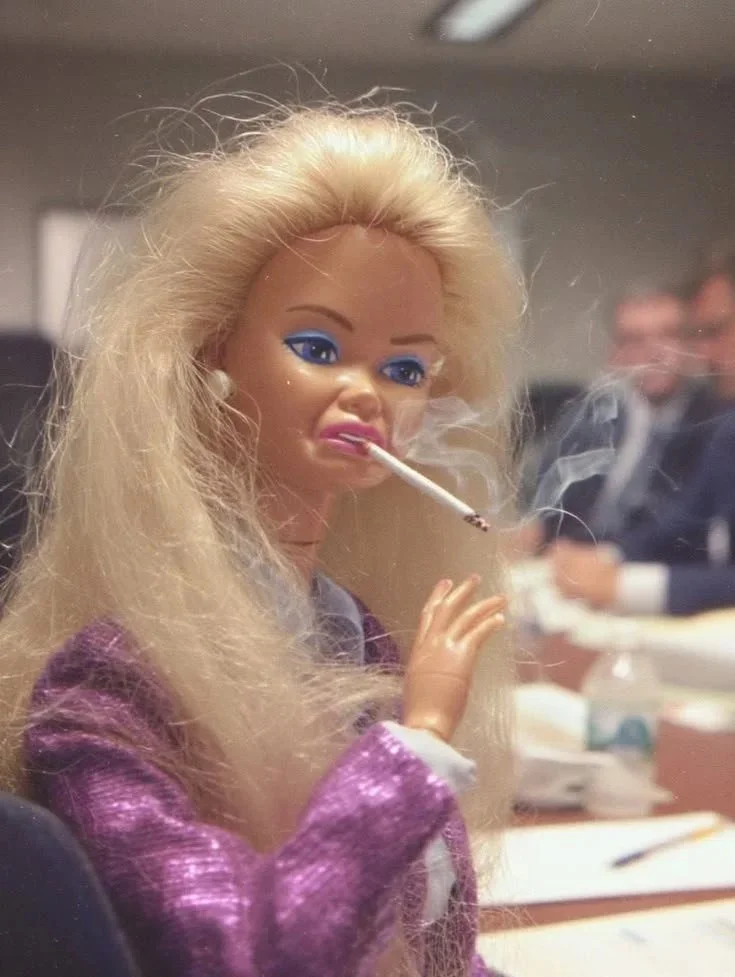
Real Life Barbie Satire -
She puts her phone face-up on the table. Screen visible. She’s here, really here, she says.
But her body is angled toward something else.
A notification.
A slot that just opened.
Somewhere she might need to be instead.
What no one talks about enough: busyness is a status system that flipped completely in less than fifty years. For centuries, the ultimate luxury was free time.
Aristocrats didn’t work ( that was the mark of their status) . Labor belonged to the lower classes.
Then something shifted.
The service economy created a new class whose value is measured in how much their time is demanded.
And within that class, not being in demand became the sign of worthlessness.
So the display inverted. You show that you’re demanded.
You show that you’re overflowing.
Rest became something to be ashamed of.
Pascal identified something even deeper: entertainment — ‘diversion’ in the original text — as flight from the self.
His argument wasn’t moral. It was anthropological. People, he said, cannot bear to remain alone with themselves in silence. Faced with the void, something unbearable surfaces. So they fill. They move. They hunt, they play, they work, they plan. Anything rather than sitting still without doing something.
What Pascal couldn’t anticipate: that three centuries later this need for diversion would be captured by an entire economy. That companies would build their models on our inability to stay quiet. That busyness would become not just psychological escape but a market signal. That burnout would be narrated as proof of dedication rather than as a system failure.
“The busy person never needs to say they’re important. They make you feel it instead.”
There’s a name for this reversal in sociological literature: ‘busyness as a status symbol.’
Researchers from Columbia and Harvard documented it in 2017 in the Journal of Consumer Research — asking participants to evaluate the social status of people described as either having free time or being overwhelmed.
Result: in contemporary Western cultures, the busy person was systematically perceived as more competent, more important, more valuable. Free time was associated with laziness or insignificance.
What makes the game particularly hard to call out: it layers over a verifiable reality. Some people genuinely are overwhelmed. The difference between real busyness and performed busyness is invisible from outside — it’s lived from inside.
The question isn’t ‘are they really busy?’
It’s ‘would they have time if they truly wanted it?’
And more subtly: ‘do they still know the difference themselves?’
Because there’s a stage of the game where the line disappears. Where the posture has become an architecture of life. Where you’re no longer choosing to be busy, you no longer know how not to be. The calendar fills automatically.
Silence becomes physically uncomfortable.
And Pascal’s question — what would surface if you stopped — stays unanswered.
Not because it has no answer.
Because you haven’t let it be asked.